

Breast Reduction Surgery in Baton Rouge, LA
Key Takeaways/Summary:
Ford Plastic and Reconstructive Surgery in Baton Rouge offers breast reduction surgery to alleviate physical pain, improve posture, and enhance emotional well-being.
Unlike lifts or augmentations, a breast reduction specifically removes excess tissue, fat, and skin to reduce breast size and weight for functional and aesthetic relief.
The personalized process involves a thorough initial consultation, a two to three-hour surgery under general anesthesia, and several weeks of guided postoperative recovery.
Carrying the weight of oversized breasts affects more than your appearance — it can affect how you move, dress, and feel every single day. Breast reduction surgery, also known as reduction mammoplasty, removes excess breast tissue, fat, and skin to reshape, lift, and resize the breasts to better fit your body and your life.
Ford Plastic and Reconstructive Surgery offers compassionate, patient-centered breast reduction surgery. Our goal is to help relieve chronic discomfort while restoring balance and confidence. Led by an experienced plastic surgeon, Dr. Chiasson, our team is dedicated to helping patients feel lighter, more comfortable, and more at ease in their bodies.
What is Breast Reduction Surgery?
Breast reduction surgery removes excess fat, tissue, and skin from the breasts to achieve a size that's proportionate to your body. For many women, this isn't a cosmetic preference — it's a relief from years of physical discomfort.
Breast reduction may also help improve self-image and your ability to participate in physical activity without restriction or pain.
A consultation with a plastic surgeon is the best first step. It's important to understand what breast reduction surgery involves — including possible risks and complications and to set realistic, individualized expectations for your results.
Is Breast Reduction Right for You?
Breast reduction may be a great option if large breasts, a condition known as breast hypertrophy, are causing any of the following:
Chronic back, neck, or shoulder pain
Skin rashes or irritation beneath the breasts
Nerve pain or restricted activity
Shoulder grooves from bra straps or poor posture
Difficulty finding clothing or bras that fit
Self-consciousness or poor body image
Younger patients often struggle with unwanted attention and difficulty staying active, while women later in life frequently deal with worsening pain and discomfort during routine mammograms. Breast reduction significantly improves quality of life for women of all ages.
Surgery may not be recommended if you smoke, have certain health conditions such as diabetes or heart problems, or want to avoid permanent scarring. You may also want to wait if you plan to have children or are considering significant weight loss, as both can affect your results.
The Procedure
The specific technique used to reduce the size of your breasts can vary based on your needs and may involve surgery through incisions, liposuction to remove excess fat, or a combination of both.
In most procedures, Dr. Chiasson will:
Make an incision around the areola and down each breast
Remove excess breast tissue, fat, and skin to reduce the size of each breast
Reshape the breast and reposition the nipple and areola to a more natural, lifted position
In the vast majority of cases, the nipple and areola remain attached to the breast on their underlying tissue — called the pedicle. Preserving the pedicle maintains both sensation and the potential for breastfeeding in the future. In rare cases involving very large reductions, the nipple and areola may need to be removed and reattached at a higher position as a skin graft.
Dr. Chiasson will work carefully to achieve symmetry between your breasts. It's worth knowing that some natural variation in size and shape between the two sides can occur. The size of the areola may also be reduced as part of the procedure to achieve a proportionate, balanced result.
Recovery & Results
After surgery, most patients experience:
Gauze dressings or bandages over the breasts, with possible drainage tubes
Tenderness, swelling, and bruising in the first days to weeks
A supportive compression bra to protect the breasts while healing
Restricted physical activity for 2 to 4 weeks; underwire bras avoided for several months
Results are visible right away, though it takes a few months for swelling to fully resolve and scars to settle. Final results are generally permanent, though aging, weight changes, and pregnancy can affect breast shape over time.
Risks to Know
As with any surgery, breast reduction carries risks including bleeding, infection, and anesthesia reactions. Additional risks include scarring, temporary bruising, changes in nipple sensation, and in some cases, difficulty breastfeeding.
Breast reduction surgery generally is at higher risk of complications and not recommended if you:
Smoke
Have certain conditions such as diabetes or heart problems
Are very obese
Want to avoid scards on your breasts.
How Breast Reduction Differs From Lifts and Augmentations
While breast reduction, breast lift, and breast augmentation are all breast procedures, they serve distinct purposes.
Breast Reduction
A breast reduction focuses on decreasing breast size by removing excess tissue and skin, addressing both functional concerns, such as pain, and aesthetic balance.
A breast lift will elevate, reshape, and firm sagging breasts, and may reposition the nipple. Loose skin is removed, but excess tissue, fat, and skin are not, so it does not significantly reduce volume.
Breast augmentation increases breast size using implants or fat transfer, but does not address drooping or loose skin. This procedure is often chosen for enhancement rather than symptom relief.
Some patients may benefit from a combination approach. Still, a breast reduction is uniquely suited for those seeking relief from the physical strain caused by large breasts while achieving a natural, proportionate appearance.
Breast Reduction - Before & After


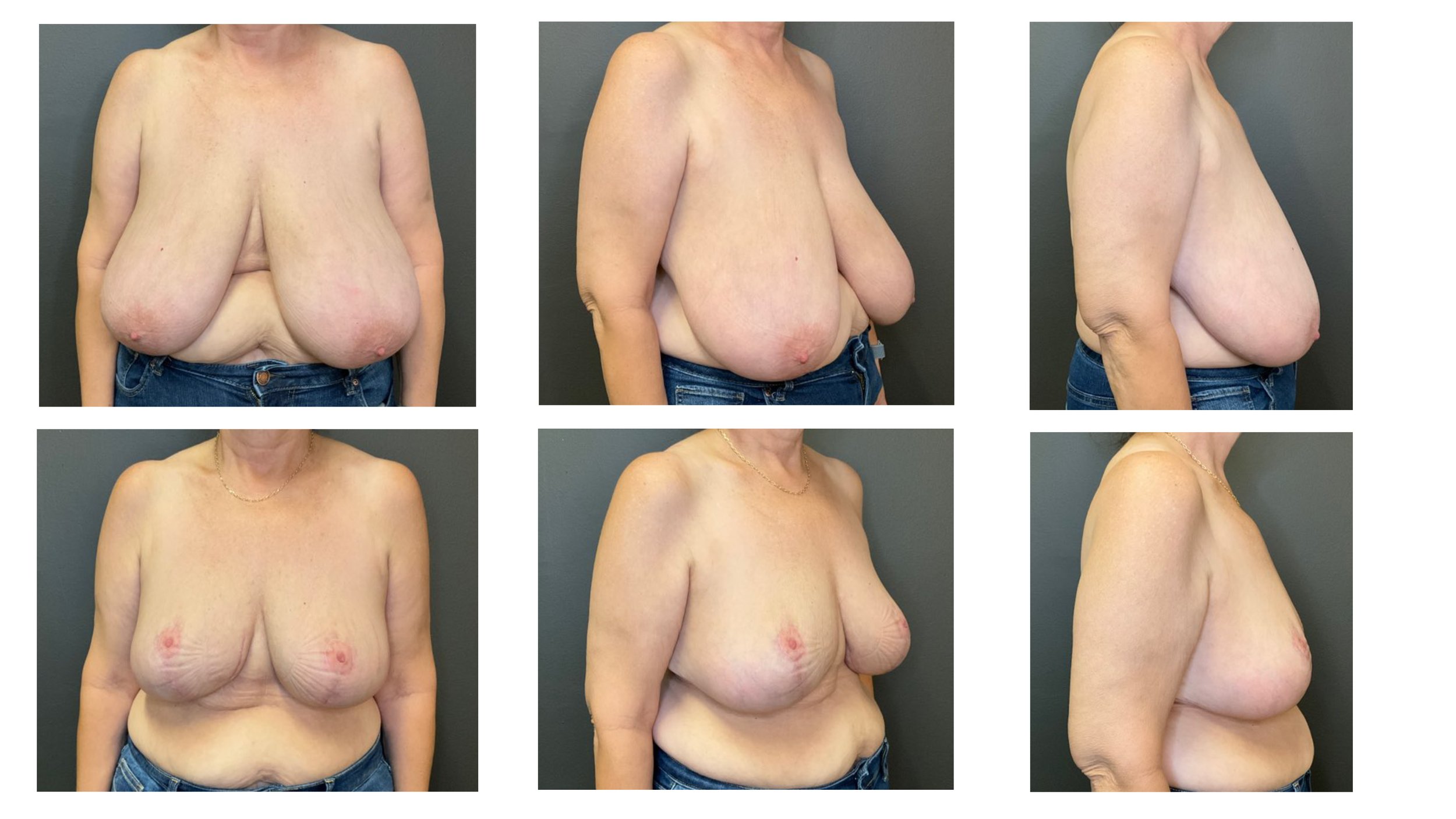


Understanding the Physical and Emotional Relief of Breast Reduction
For many patients, breast reduction surgery can lead to significant relief from persistent back, neck, and shoulder pain, as well as discomfort from bra strap grooving or skin irritation beneath the breasts.
Beyond the physical benefits, breast reduction can provide meaningful emotional relief. Many individuals feel self-conscious or limited in clothing choices and physical activities due to breast size. By creating a more proportionate breast shape that aligns with your body frame, breast reduction can improve posture, mobility, and overall quality of life. Our approach prioritizes both function and aesthetics, ensuring results that feel as good as they look.
Breast Reduction Client Testimonial
Ask The Expert
Dr. Kate Chiasson

-
You may be a great candidate if your breast size is causing chronic back, neck, or shoulder pain, skin irritation, restricted activity, or self-consciousness — regardless of how large your breasts actually are. What matters is that your breast size is disproportionate to your frame and affecting your quality of life.
The best way to find out is a personal consultation. I'll evaluate your health, your goals, and your anatomy and give you my honest recommendation from there.
-
It depends on your plan, and it's always worth checking. When breast reduction is performed to relieve documented physical symptoms, many insurance providers consider it medically necessary. Most require pre-certification before approving coverage, so I recommend starting that conversation with your insurer early.
Many of my patients also choose private pay, which gives them more flexibility over the final result without the size restrictions insurance criteria can sometimes impose. My team will help you understand your options.
-
At your pre-operative visit, I'll review your medical history, examine and measure your breasts, discuss your size goals, and walk you through exactly what to expect on surgery day — including anesthesia, likely scarring, and possible changes in sensation. In the weeks leading up to surgery, you'll be asked to:
Complete any required lab work and get a baseline mammogram
Stop smoking for at least 4 to 6 weeks before and after surgery
Avoid aspirin, ibuprofen, and herbal supplements that can increase bleeding
Arrange for someone to drive you home after the procedure
My team will give you a full pre-op checklist and is always available to answer questions as your surgery date approaches.
-
All breast reduction techniques result in permanent scars. That said, scars typically fade significantly over time, and your genetics play the biggest role in how yours will heal and appear.
I take care to place incisions as discreetly as possible and will give you guidance on scar care after surgery. For most of my patients, the relief from pain and the improvement in day-to-day life far outweigh any concerns about scarring.
-
This is one of the most important questions I discuss with patients of childbearing age. In virtually all of the breast reductions I perform, I preserve the nipple-areolar complex on its underlying breast tissue — a technique that's specifically designed to maintain the connection between the nipple and the milk ducts. This keeps the possibility of breastfeeding open for most patients.
That said, I can't guarantee it, and the amount of glandular tissue removed is also a factor. If future breastfeeding is a priority for you, please bring it up during your consultation. It's an important part of how I'll plan your surgery.
-
Most patients are back to light daily activities within one to two weeks. I typically recommend avoiding strenuous exercise and heavy lifting for four to six weeks while you heal. You'll wear a supportive bra during this time and come in for follow-up visits so I can monitor your progress.
You'll notice a change in size and shape right away, but swelling takes a few months to fully settle. Most patients tell me the recovery was much more manageable than they expected, and the relief they feel makes it absolutely worth it.
Your Personalized Journey: From Consultation to Breast Reduction Recovery
Ford Plastic and Reconstructive Surgery will work closely with you to understand your true needs. We understand that your concerns are unique, and we work diligently to create a personalized treatment plan that meets your needs. Your journey begins with a thorough consultation, where Dr. Chiasson will listen carefully to your concerns, review your medical history, and discuss your goals. Together, you'll determine whether breast reduction is the right option and what outcome best supports your comfort and lifestyle.
Breast reduction surgery is typically performed under general anesthesia, and usually lasts two to three hours. Our team pays careful attention to preserving breast shape, symmetry, and sensation whenever possible.
Recovery varies by individual, but most patients can expect several weeks of gradual healing. Our team provides detailed postoperative guidance, follow-up care, and ongoing support to ensure a smooth recovery and optimal results.

Life is Better When You're Comfortable in Your Skin
If you are experiencing discomfort or limitations due to large breasts, breast reduction surgery may offer lasting relief and renewed confidence.